





Gravity Die Casting: A Time-Tested Metal Forming Technique
When it comes to manufacturing metal parts, Gravity die casting might not be as flashy as high-pressure die casting, but it plays a crucial role in automotive, machinery, and other industries. Gravity die casting-also referred to as permanent mold casting in North America-is a metal forming method where molten non-ferrous alloy is poured into a reusable steel or iron mold and fills the cavity under its own weight, without applied pressure. The mold (or die) is typically split along a parting line, clamped shut for pouring, and opened for part removal once solidification is complete. It's one of the oldest precision casting routes still in active production, and for good reason.Put simply, this process involves pouring molten metal into a metal mold and letting gravity do the work-the metal flows naturally into the cavity, cools down, and you've got your part.
This method works particularly well for small to medium-sized components like engine blocks, pump housings, and gearbox cases. Why go with gravity die casting? Because it delivers quality while letting you reuse the same mold thousands of times, which really pays off in the long run.
For anyone researching what gravity casting actually involves at a practical level: you're looking at a process where a foundry operator (or an automated tilting machine) controls the pour rate into a permanent metal die, the metal solidifies directionally from the mold walls inward, and the finished casting gets ejected once it's cooled enough to hold its shape. No vacuum, no high-pressure injection-just controlled filling under atmospheric conditions. The simplicity is deceptive, though, because the quality of the final part depends entirely on how well the mold was designed and how precisely the process parameters are held.
The gravity casting process itself is more straightforward than most people expect. It breaks down into a handful of steps, though each one has plenty of room to go wrong if you're not paying attention.
First, the mold gets preheated-usually somewhere between 200°C and 350°C depending on the alloy. Skip this or get the temperature wrong, and you'll end up with premature solidification and incomplete fills. Next, a refractory coating is sprayed onto the cavity surfaces. This coating serves double duty: it controls how quickly heat transfers from the melt to the mold, and it prevents the casting from welding itself to the die.
Once the mold is prepared, molten metal gets poured through the gating system. In a standard gravity mold casting setup, the operator controls pour speed manually with a ladle, though many shops today use tilt-pour machines that rotate the entire die assembly to manage fill rate more precisely. After the cavity is full, solidification happens from the mold walls inward-a directional cooling pattern that actually helps feed shrinkage and reduce internal voids.
The whole cycle, from pour to part ejection, typically runs 2 to 8 minutes depending on part size. Not as fast as high-pressure methods, but fast enough for production runs where part integrity matters more than raw output speed.

What Sets Gravity Die Casting Apart from Die Casting?
A lot of people mix these two up. The key difference comes down to how the metal fills the mold:
- Gravity die casting: Workers ladle molten metal into the mold-it's all about natural gravity flow
- Die casting: Machines force the metal in under serious pressure, anywhere from tens to hundreds of MPa
This fundamental difference shapes how each process gets used. Die casting excels at high-volume production (think thousands of phone cases daily), prioritizing speed. Gravity die casting leans toward smaller batches but delivers dimensional accuracy within ±0.2-0.5mm and surface roughness down to Ra 3.2-critical specs for precision mechanical components.
There's another major distinction that often gets overlooked in the gravity casting vs die casting debate: heat treatability. High-pressure die castings trap tiny gas pockets during injection, and when you put those parts through solution heat treatment, the trapped air expands and blisters the surface. That's why HPDC parts almost always stay in as-cast condition.
Gravity die castings, on the other hand, fill slowly enough that gas has time to escape through vents. The result is a low-porosity structure that responds well to T6 heat treatment-solution treatment followed by artificial aging. For an alloy like A356, going from as-cast to T6 condition can push ultimate tensile strength from around 170 MPa up past 260 MPa. If your parts need to carry structural loads or pass pressure-tightness testing, that capability alone can be the deciding factor.
It's also worth noting that sand casting offers heat treatability too, but with significantly looser tolerances (CT11-CT13 vs CT7-CT9 for gravity die) and rougher surfaces. So when the die casting vs gravity casting comparison comes up in project planning, the real question is usually about where your volume sits and whether you need that post-cast strengthening.

Why Choose Gravity Die Casting?
Dimensional Stability You Can Count On
Without external pressure interfering, the metal solidifies more uniformly. It's kind of like baking a cake-slow and steady beats rushed and pressurized every time. In real-world production, gravity cast parts typically show 20-30% less dimensional variation compared to die castings.
Superior Surface Quality
Parts often come out of the mold needing minimal post-processing. I've seen automotive steering knuckles where gravity cast pieces just needed a quick polish, while sand castings required extensive grinding to get anywhere close.
Handles Complex Geometries
With smart gating system design, you can cast thin-wall sections down to 2-3mm thick, even with internal cooling channels. Some high-end motorcycle engine cases? Yep, made this way.
Solid Mechanical Properties
Take A356 aluminum alloy as an example-gravity die casting delivers tensile strength around 240-280 MPa with 3-5% elongation. That's plenty robust for load-bearing applications.
A356 gets the most attention, but alloy selection for gravity die aluminum casting goes deeper than picking the popular option. A357 substitutes a higher magnesium content that bumps strength further-useful for aerospace brackets and suspension components where every MPa counts. LM25 (the British designation for a similar Al-Si7Mg composition) dominates in European automotive specs. For parts exposed to marine or chemical environments, LM6 (Al-Si12) trades some strength for outstanding corrosion resistance and fluidity that fills thin sections cleanly.
Beyond aluminum, the process handles copper-based alloys for electrical and thermal management parts-think heat sinks and bus bars-and zinc alloys like ZA-12 when you need higher hardness and bearing properties without switching to machining from solid stock.
The alloy you choose also influences your gravity die casting mould material selection. Aluminum melts pour at 680–750°C, and H13 tool steel handles that range comfortably for tens of thousands of cycles. But if you're casting a copper alloy at 1050°C+, the die needs to be either a high-grade hot-work steel with aggressive cooling or a specialized tungsten-based alloy to survive the thermal load.

Where Gravity Die Castings End Up
The automotive sector accounts for the largest share of gravity die casting production by a wide margin. Cylinder heads and intake manifolds are classic examples-parts with internal coolant passages formed by sand cores set inside the permanent mold before each pour. Gravity casting aluminum engine blocks remain common in performance and mid-volume platforms where the low porosity supports the cylinder bore honing process without subsurface voids causing failures down the line.
Transmission housings and suspension knuckles are another major category. A dedicated gravity die casting machine for automotive parts molding-often a tilt-pour unit with hydraulic core pulls-can cycle through several hundred of these per shift while maintaining the dimensional consistency that downstream CNC operations depend on.
Outside of automotive, industrial gravity casting covers a broad range: valve bodies for oil and gas, pump housings for water treatment, and gearbox enclosures for heavy equipment. These parts tend to be thicker-walled and heavier, often 5–15 kg per piece, and the slower fill rate of gravity pouring actually works in their favor by minimizing turbulence-related oxide inclusions.
Aerospace represents the higher-end applications. Precision gravity-cast components like actuator housings and avionics enclosures need to meet tighter specs-typically ±0.3mm or better after machining-and often require X-ray inspection to verify internal soundness. The alloy of choice here is usually A357-T6 for its superior fatigue resistance.
One area that's been growing is aluminum gravity casting thin wall parts for LED lighting housings and electronic enclosures. Wall thicknesses of 2.5–3.5mm are achievable with proper gating and mold temperature control, giving these parts good heat dissipation characteristics without the tooling cost of high-pressure die casting.
Mold Design Makes All the Difference
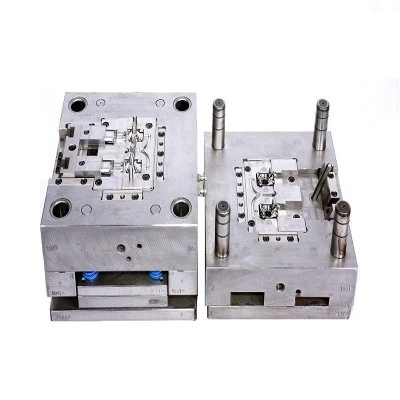
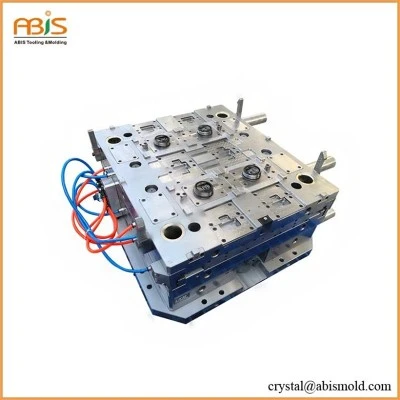
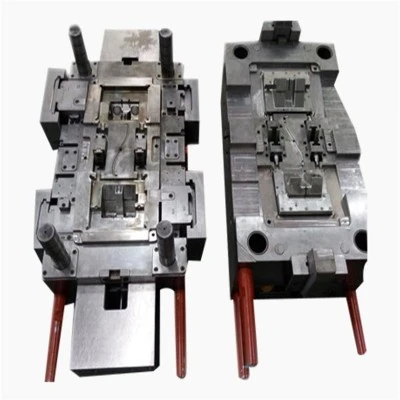
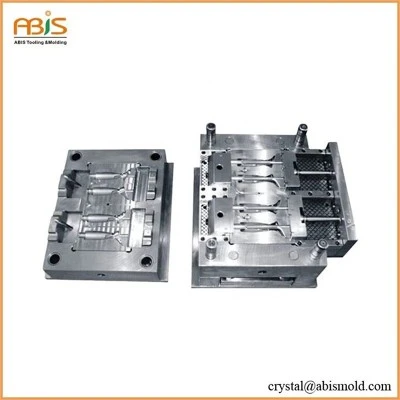
Gravity die casting molds typically split into upper and lower halves that clamp together during pouring and separate for part removal. A single mold can handle anywhere from several thousand to tens of thousands of cycles, driving per-part costs way below single-use sand molds.
Material selection matters-big time. Since the mold repeatedly contacts aluminum melt at 700-750°C (or over 1000°C for copper alloys), regular steel just won't cut it. Today's go-to materials are high-conductivity copper alloys like beryllium copper or chromium-zirconium copper, with thermal conductivity 3-4 times higher than steel. This rapid heat dissipation speeds up production cycles while preventing the mold itself from cracking.
Cavity design is where things get really interesting. Gate placement, vent positioning, cooling channel routing-every detail affects final part quality. I worked on a case where a customer kept getting porosity in the same spot on their pump bodies. Turned out the venting was inadequate. We relocated two vent plugs and the problem disappeared.
Mold quality drives everything, but it's fair to ask what that investment actually looks like. Gravity die tooling for a simple bracket or cover plate might run $5,000–$12,000. A multi-core mold for something like a valve body or manifold? You're looking at $20,000–$45,000, factoring in the steel, CNC time, and trial iterations. That's substantially less than comparable HPDC tooling, which often starts above $50,000 and can exceed six figures for large automotive dies.
Where the gravity mold really earns its keep is longevity. A well-maintained H13 steel die running aluminum alloys will handle 30,000–80,000 shots before major refurbishment, and sometimes more if the part geometry isn't too aggressive on the core pins. Compare that against sand casting, where every single pour consumes a new mold-at high volumes the per-piece economics flip quickly in permanent mold's favor.
For production planning, gravity die casting production volumes typically sit in a sweet spot between 500 and 50,000 units per year per part number. Below 500, sand casting or investment casting often makes more sense economically. Above 50,000, high-pressure die casting's faster cycle times start delivering lower unit cost despite the higher tooling entry point.
Most experienced gravity die casters can turn around first articles in 6–10 weeks from design freeze, including mold fabrication, sampling, and dimensional validation. If you're working with a vertically integrated supplier that handles gravity die cast mold building, machining, and surface treatment under one roof, that timeline can compress further by eliminating hand-off delays.
Getting Consistent Results from Every Pour
No casting process is immune to defects, and gravity diecasting has its own set of usual suspects. Porosity from dissolved hydrogen is the most common-aluminum picks up gas from moisture in the atmosphere, and if your melt degassing isn't thorough, you'll see it in cross-sections. Cold shuts happen when two metal fronts meet but don't fuse properly, typically caused by a mold that's running too cold or a pour speed that's too slow.
The practical fixes aren't exotic. Rotary degassing before pouring keeps hydrogen content below 0.15 mL/100g. Maintaining mold surface temperature above 250°C at pour time prevents premature freezing. And simulation software-tools like MAGMASOFT or ProCAST-lets you spot problem areas in gating and venting before cutting any steel.
For incoming quality on finished gravity die castings, the standard toolkit includes fluorescent penetrant inspection for surface cracks, X-ray for internal porosity on critical parts, and CMM dimensional checks against the 3D model. Parts going into pressure-containing applications (like hydraulic manifolds) also need leak testing, either with air pressure decay or helium mass spectrometry depending on how tight the spec is.