





What is squeeze casting?
The casting method of forming and solidifying metal under pressure is called extrusion casting.Its technological process is shown in the figure below.
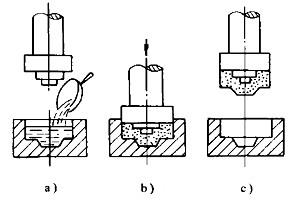
Extrusion casting process schematic diagram.
A) pour b) extruded c) open type.
When the castings are formed with local plastic deformation, the solidified castings at high pressure are finer, which can basically eliminate the loose and stoma in the casting and improve the mechanical properties.The casting dimension is high, the surface is clean and the shrinkage rate is high.However, the inclusion of metal fluid is not easy to be excluded in pouring, and the height of the casting is sometimes difficult to control, and the surface of the casting is easy to form cold insulation.
The extrusion casting method is also used in the manufacture of aluminum - iron bimetal castings and fiber reinforced metal matrix composites (such as carbon-fiber composite materials).
Squeeze casting represents a revolutionary advancement in metal forming technology, combining the best aspects of casting and forging processes to produce high-quality metal components. This sophisticated manufacturing technique, also known as liquid metal forging or squeezing die casting, has emerged as a critical process in modern industrial applications where superior mechanical properties and dimensional accuracy are paramount.
Key Insight
Squeezing die casting bridges the gap between traditional casting and forging, offering the design flexibility of casting with the mechanical properties approaching those of forging.
Fundamental Principles of Squeeze Casting
Squeeze casting operates on the principle of applying high pressure to molten metal as it solidifies within a die cavity. Unlike conventional casting methods, squeezing die casting involves the controlled application of mechanical force during the solidification process, typically ranging from 50 to 150 MPa.
This pressure application fundamentally alters the microstructure of the solidifying metal, resulting in components with enhanced mechanical properties and reduced porosity.
The process begins with the preparation of a preheated die, usually maintained at temperatures between 200°C and 400°C depending on the alloy being processed. Molten metal is then poured into the lower die half, followed by the immediate closure of the upper die. The critical aspect of squeezing die casting lies in the precise timing and magnitude of pressure application, which must occur while the metal remains in a semi-solid state to achieve optimal results.

Technical Process Variations
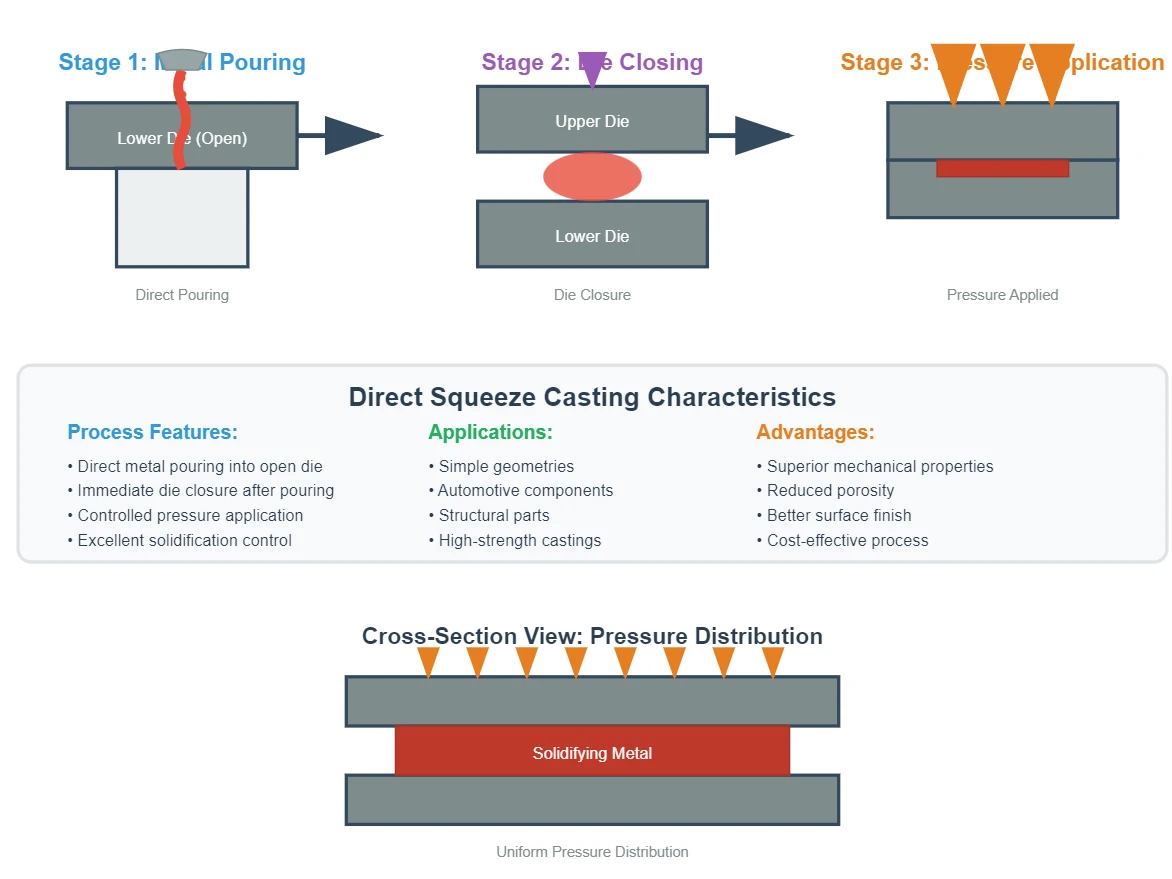
Direct Squeeze Casting
Direct squeeze casting involves pouring molten metal directly into an open die cavity, after which the die closes and applies pressure. This method is particularly effective for producing relatively simple geometries and offers excellent control over the solidification process.
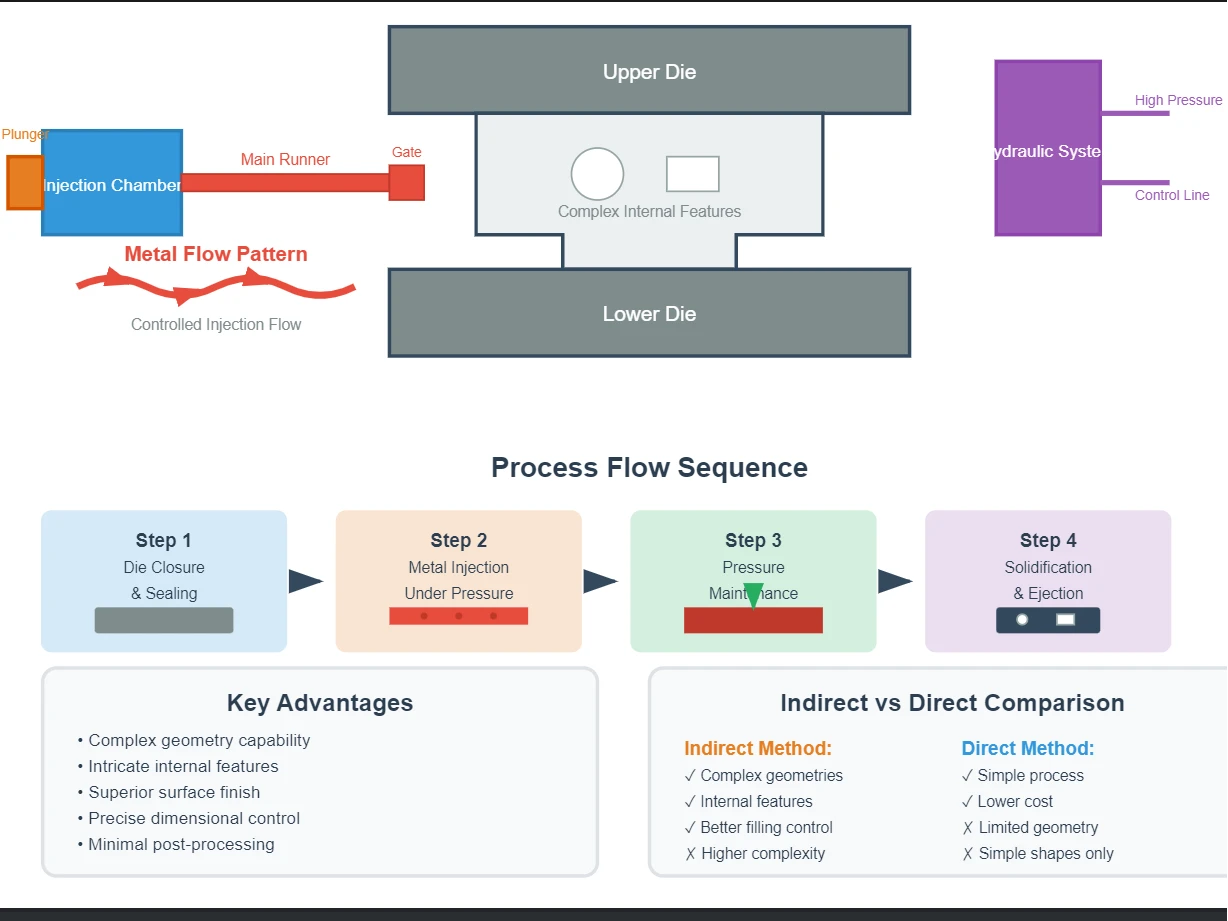
Indirect Squeeze Casting
Indirect squeeze casting utilizes a more complex approach where molten metal is injected into a closed die through a runner system under pressure. This variation of squeezing die casting provides superior capability for producing complex geometries with intricate internal features.
Comparison of Squeeze Casting Methods

Material Compatibility and Applications
Squeezing die casting demonstrates exceptional versatility in terms of material compatibility, with aluminum alloys representing the most commonly processed materials. The process excels with various aluminum alloys, producing components with significantly improved strength-to-weight ratios compared to conventional casting methods.
| Alloy Type | Key Properties | Common Applications |
|---|---|---|
| Aluminum-Silicon | Good castability, wear resistance | Engine components, housings |
| Aluminum-Copper | High strength, heat resistance | Structural aerospace components |
| Aluminum-Magnesium | Lightweight, corrosion resistant | Automotive suspension parts, marine components |
| Magnesium Alloys | Ultra-lightweight, high strength-to-weight ratio | Aerospace structures, high-performance automotive parts |
| Copper Alloys | High thermal/electrical conductivity | Heat exchangers, electrical components |
Automotive Industry
The automotive industry has embraced squeezing die casting for producing critical components such as suspension arms, engine brackets, and transmission housings.
Aerospace Applications
Aerospace applications benefit from the superior mechanical properties achievable through squeezing die casting, particularly for components requiring high fatigue resistance.
General Engineering
Various industrial sectors utilize squeezing die casting for producing high-strength components with complex geometries and tight dimensional tolerances.
Microstructural Advantages
The application of pressure during solidification in squeezing die casting produces distinctive microstructural characteristics that directly translate to superior mechanical properties. The high pressure promotes directional solidification, reduces shrinkage porosity, and refines the grain structure of the cast component.
These microstructural improvements result in enhanced tensile strength, improved fatigue life, and superior surface finish compared to conventional casting processes.
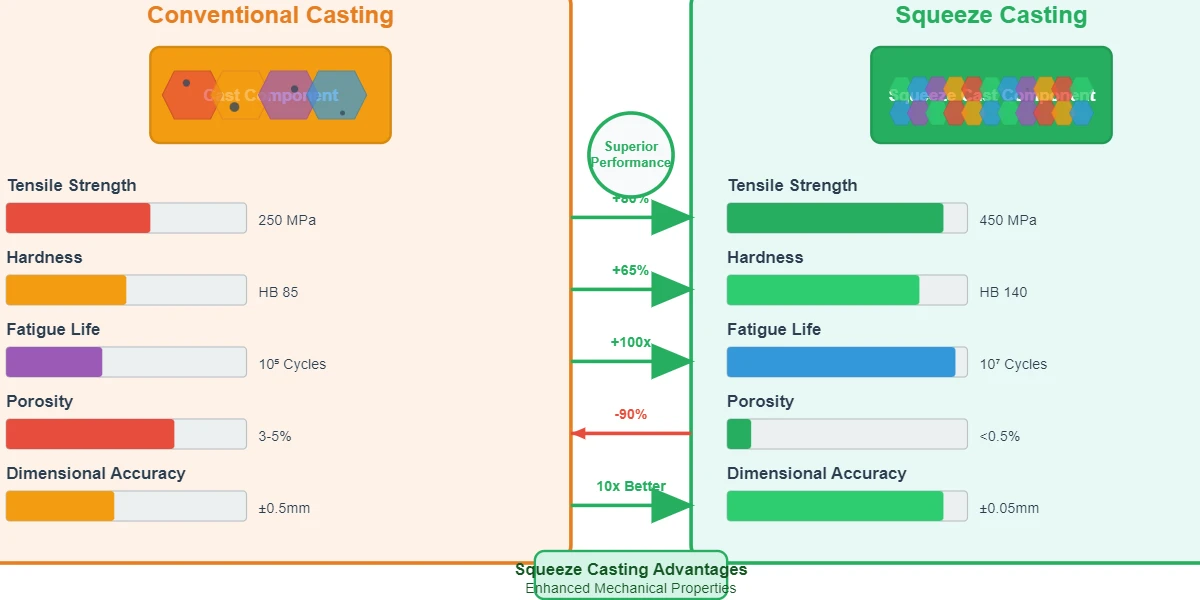
Research has demonstrated that components produced through squeezing die casting exhibit porosity levels below 1%, significantly lower than the 3-5% typically observed in conventional gravity casting. This reduction in porosity directly correlates with improved mechanical properties, making squeezing die casting an ideal choice for structural applications requiring high reliability.
Key Microstructural Benefits
Refined grain structure for improved strength
Reduced porosity (typically below 1%)
Elimination of shrinkage defects
Uniform distribution of alloying elements
Improved intermetallic phase distribution

Microstructure comparison: conventional casting (left) vs. squeeze casting (right)
Porosity Comparison

Equipment and Tooling Considerations
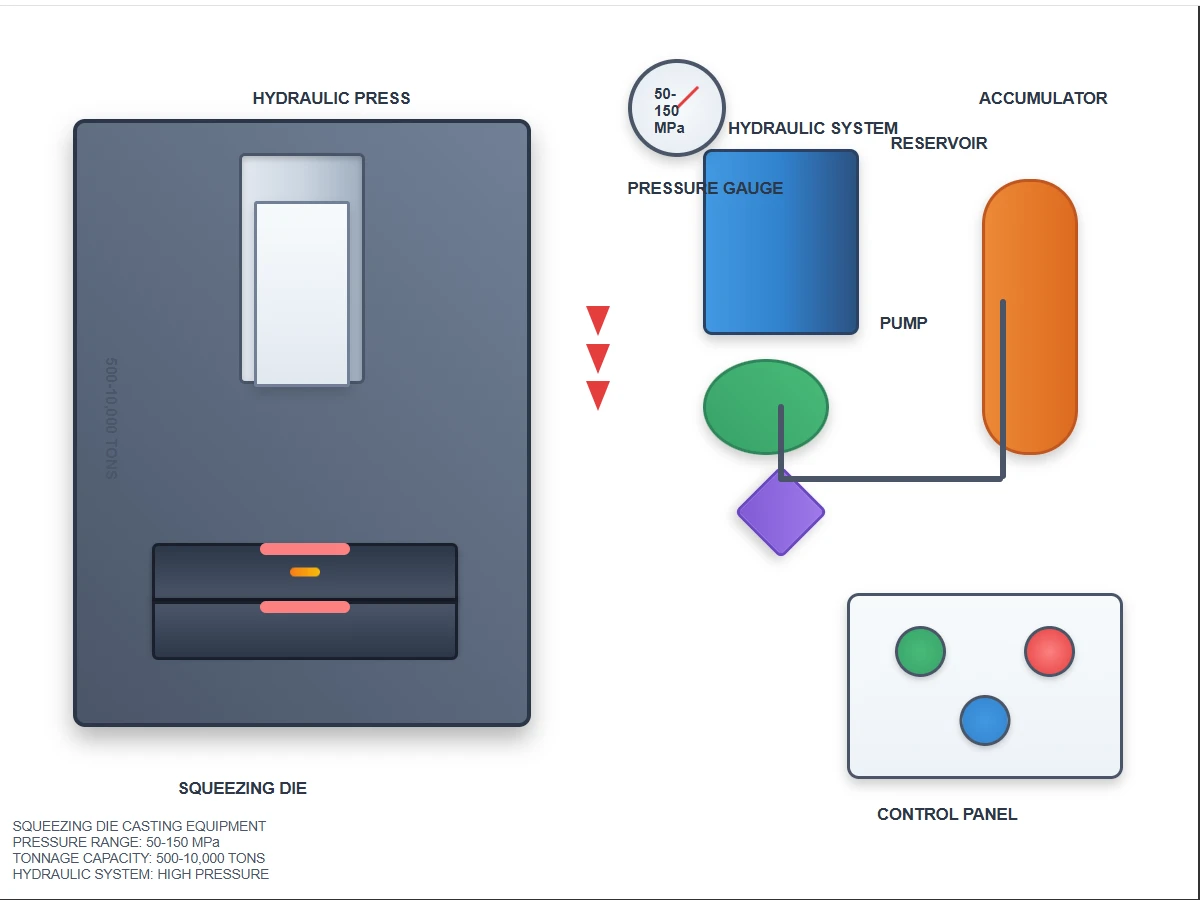
Successful implementation of squeezing die casting requires specialized equipment capable of generating and maintaining the high pressures necessary for the process. Hydraulic presses with capacities ranging from 500 to 10,000 tons are commonly employed.
The specific tonnage requirements are determined by the projected area of the component and the desired pressure levels, typically between 50 to 150 MPa for effective squeezing die casting results.
Die Design and Tooling
Die design for squeezing die casting presents unique challenges, as the tooling must withstand repeated exposure to high temperatures and pressures while maintaining dimensional accuracy.
Tool steels such as H13 and H11 are frequently selected for their combination of hot strength, thermal conductivity, and wear resistance. Proper die cooling and heating systems are essential for maintaining the precise temperature control required for optimal squeezing die casting results.
Critical Die Design Features
Precise temperature control channels
Proper venting to eliminate gas entrapment
Robust guidance systems for die alignment
Optimized gate design for proper metal flow

500-10,000
Typical press capacities (tons)
Hydraulic presses designed specifically for the high-pressure requirements of squeezing die casting processes.
50-150
Pressure range (MPa)
Innovation is our DNA, innovation not only refers to product innovation, but also includes.
200-400°C
Die temperature range
Collaboration is to do our best for customers, so as to achieve win-win cooperatio
Process Parameters and Quality Control
Achieving consistent quality in squeezing die casting requires precise control of numerous process parameters. Die temperature, metal pouring temperature, pressure application timing, and holding pressure magnitude all significantly influence the final component properties.
Critical Process Parameters
Die Temperature
Typically 200-400°C, varies by alloy type, critical for proper flow and solidification in squeezing die casting.
Metal Temperature
650-750°C for aluminum alloys, precisely controlled to ensure proper flow during squeezing die casting.
Pressure Timing
Applied during semi-solid phase, critical timing ensures optimal microstructure development in squeezing die casting.
Holding Pressure
Maintained until complete solidification, ensures minimal porosity in squeezing die casting components.
Quality Control Measures
Quality control in squeezing die casting typically involves comprehensive mechanical testing, including tensile testing, fatigue testing, and microstructural analysis.
Non-destructive testing methods such as X-ray radiography and ultrasonic testing are employed to verify the internal integrity of components produced through squeezing die casting.
Dimensional Inspection
Precise measurement to ensure compliance with tight tolerances achievable through squeezing die casting.
Mechanical Testing
Tensile, hardness, and impact testing to verify mechanical properties enhanced by squeezing die casting.
Microstructural Analysis
Examination of grain structure and phase distribution in components from squeezing die casting.
Non-Destructive Testing
Ultrasonic and X-ray inspection to detect internal defects in squeezing die casting components.
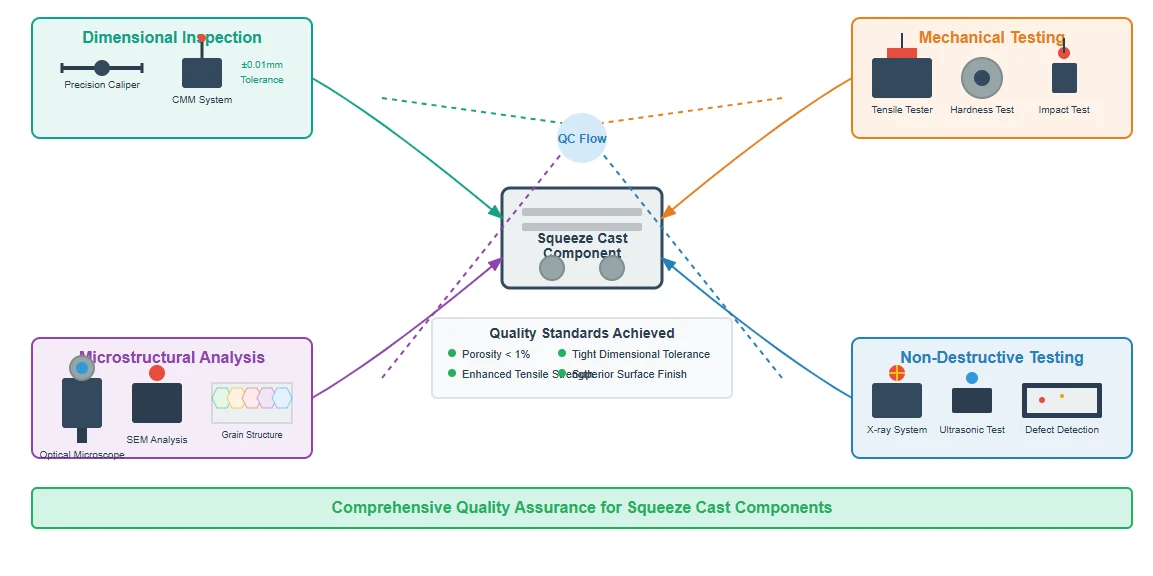
Quality control testing of squeeze cast components using advanced measurement systems
Mechanical Properties Comparison
Economic and Environmental Considerations
Economic Advantages
While the initial investment for squeezing die casting equipment is substantial, the process offers significant long-term economic advantages. The superior mechanical properties achievable through squeezing die casting often eliminate the need for additional heat treatment operations, reducing overall manufacturing costs.
Additionally, the excellent surface finish characteristic of squeezing die casting frequently eliminates secondary machining operations, further reducing production time and costs.
Cost Savings Opportunities
Elimination of heat treatment processes
Reduced machining requirements
Higher production yields
Longer tool life compared to some casting processes
Integration of multiple components into single parts
Environmental Benefits
Environmental benefits of squeezing die casting include reduced material waste due to the process's ability to produce near-net-shape components. The elimination of secondary operations also contributes to reduced energy consumption and lower overall environmental impact compared to conventional manufacturing routes.
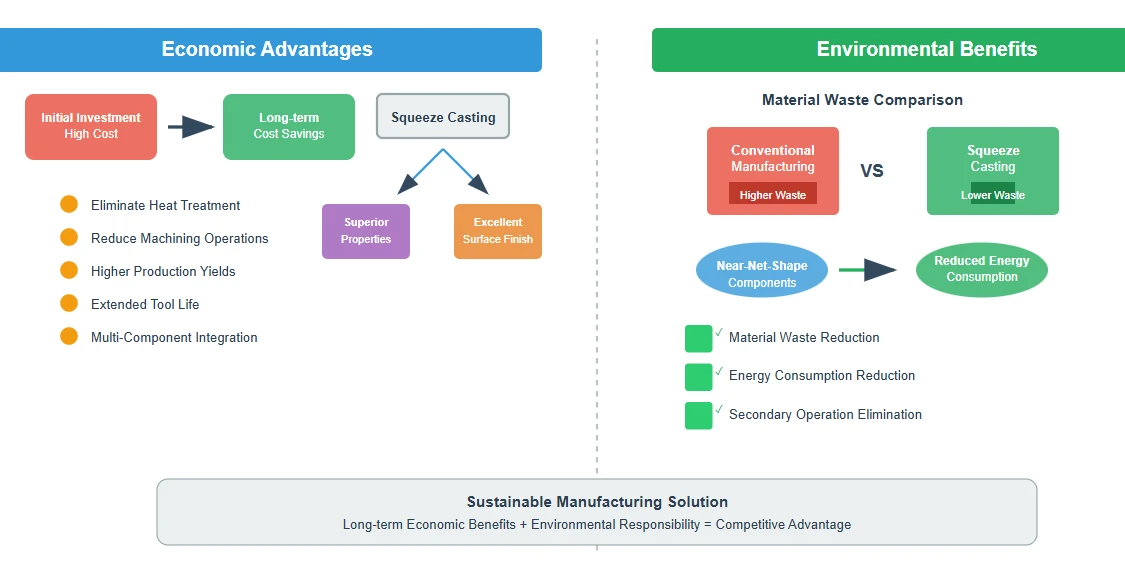
Reduced material waste in squeeze casting compared to conventional manufacturing methods
Why Choose Squeezing Die Casting?
Squeezing die casting represents a significant advancement in metal forming technology, offering a unique combination of design flexibility, material properties, and manufacturing efficiency. By applying high pressure during solidification, squeezing die casting produces components with superior mechanical properties, reduced porosity, and excellent dimensional accuracy, making it an ideal choice for demanding applications across automotive, aerospace, and general engineering sectors.
Additional Resources on Squeeze Casting
Technical Literature
In-depth research papers and technical publications on the science and applications of squeezing die casting.
Process Videos
Visual demonstrations of the squeezing die casting process, from metal preparation to final component extraction.
Case Studies
Real-world applications of squeezing die casting in various industries, highlighting performance benefits.